

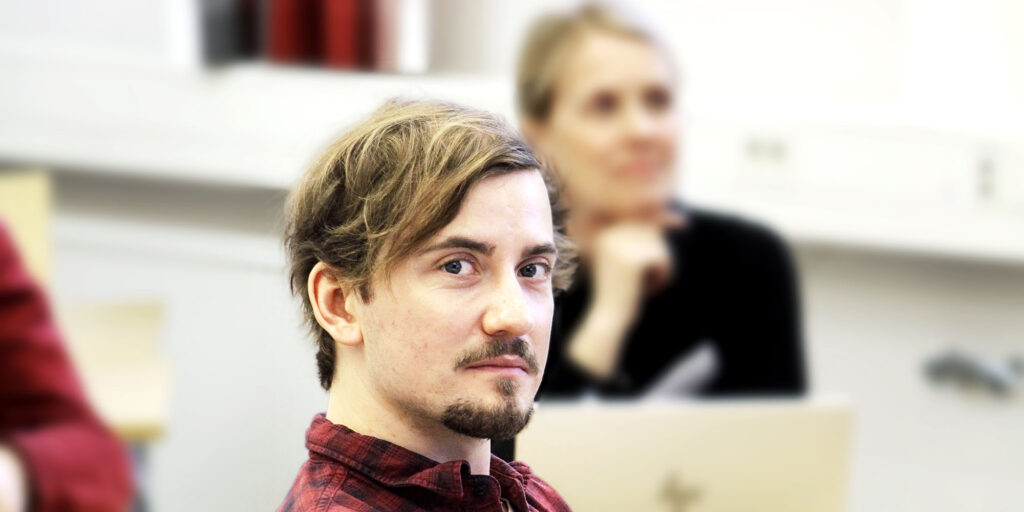
Wind Power Has an Impact. – We definitely see that offshore wind power affects the marine environment, but the effects are multifaceted and sometimes difficult to categorize as positive or negative, says Samuel Morsbach, a PhD student in marine biology affiliated with C2B2.
TECHNOLOGY. Producing energy is somewhat problematic. Burning wood spreads particles, oil and nuclear power have their downsides, and hydropower has a major impact on rivers. For Samuel Morsbach, a PhD student at Tjärnö Marine Laboratory, offshore wind power and its effects on the marine environment are the focus.
– The technology clearly affects marine life, he says.
Whether it is worth the effort or not is not really the point of his work. Samuel Morsbach says his research is not about taking a position for or against offshore wind power. He describes it as a necessary technology for addressing major global challenges.
– It can help us reduce greenhouse gas emissions and become less dependent on international actors. And therefore also less vulnerable to crises such as the wars in Ukraine and Iran. I believe the expansion is inevitable, he says.
At the same time, it is hardly surprising that wind turbines hundreds of meters tall, placed on foundations weighing thousands of tons, will affect the marine environment.
That is why it is important to understand and predict those effects.
– So that we do not create new problems while trying to solve old ones, says Samuel Morsbach.
In April, he held his midterm seminar for his doctoral work at Tjärnö Marine Laboratory. Not only supervisors and researchers attended — representatives from the wind power industry were also present, reflecting the strong interest in the findings.
Focus on the Southern Skagerrak
In his research, he has created a two-dimensional model of the marine environment in the southern Skagerrak. This area is also the focus of C2B2’s LivingLab West project, in which he participates.
There — roughly halfway between Marstrand and Skagen — the wind power company Zephyr is planning the Poseidon facility with around 50 to 80 floating wind turbines, each 260 to 340 meters tall. Annual energy production is estimated at up to 5,500 gigawatt-hours, corresponding to approximately four percent of Sweden’s electricity demand.
Samuel Morsbach is now investigating what impact the facility could have. In his model, he has incorporated simulations of 17 different groups of species, ranging from seals and porpoises to seabirds, fish, shellfish, and plankton, as well as how they are interconnected through the marine food web.
The model simulates four different impact factors when the wind farm is in operation. One concerns the large amounts of foreign material introduced into the environment during construction. In addition, underwater noise spreads through the water when the turbines are running. Another impact is the barrier effect experienced by birds traveling over or through the waters. Finally, there is an effect on fishing, since commercial fishers cannot operate within the wind farm area.
Advantages and Disadvantages
However, not everything is necessarily negative. The foundations, for example, could benefit certain species, such as blue mussels that settle on the new surfaces — something known as the reef effect. Other species may lose their usual seabed habitats. As for noise, marine mammals are the ones most negatively affected.
– There is low-frequency noise during operation. Then there is also quite a lot of high-frequency noise during the construction and decommissioning of a turbine. Those periods are shorter, but the effects are more severe, he says.
The noise drives away seals and porpoises.
At the same time, he points out that the simulations are naturally based on a number of assumptions. For example, there is limited data on how marine mammals respond to low-frequency sound, and the simulations assume the worst-case scenario.
– It could also be that they become accustomed to it.
The barrier effect on birds is significant. Seabirds generally prefer not to cross through wind farms.
– The collision risk is high, but the impact varies somewhat depending on the species.
For commercial fishers, the impact is direct. According to Samuel Morsbach, they will obviously lose fishing grounds. At the same time, there could be what is known as a spillover effect.
– If fish populations grow within the wind farm, partly because of reduced fishing pressure, this could lead to larger stocks even outside the wind farm, in areas where fishing is allowed. Potentially, that could compensate for the loss of fishing grounds.
However, there are not yet any reliable figures on this, although Samuel Morsbach believes it could be investigated using the model he is working with.
– But in that case, I would need to further develop the model so that it better accounts for the economic aspects of fishing, he says.
A movement of biomass
Now, halfway through his dissertation, what conclusions can he draw?
According to Samuel Morsbach, it is unequivocal that offshore wind farms have a strong overall impact on local marine ecosystems. Among other things, there is a redistribution of biomass. However, he says, it is not self-evident that this impact is negative.
– It can be both positive and negative, depending on which species you examine.
When it comes to marine mammals, offshore wind power is a relevant environmental stress factor. According to Samuel Morsbach, however, more knowledge is needed about the strength of the noise impact.
A third conclusion is that he observes both cumulative effects and cascading effects. Even if individual species are not directly affected by the structures, they may still be impacted because species depend on one another.
– To quantify long-term effects, we must take those relationships into account.
Your dissertation is due to be completed in spring 2028. Where will you do your postdoc?
– So far, there are no concrete plans. But I have been in contact with many people during my research, and there is strong interest in offshore wind power and ecosystem modeling. I am optimistic that I will find something.
Could you imagine working outside academia as well?
– Yes, absolutely. There are many opportunities.
Facts: Samuel Morsbach
Occupation: Since 2023, PhD student at the Department of Marine Sciences. Affiliated with C2B2’s Work Package 1, Open Ecosystems and Climate Change, and involved in LivingLab West.
Age: 28
Residence: Tjärnö
Family: Girlfriend.
Interests: Cello, diving, and kayaking
Photo: Thomas Drakenfors