

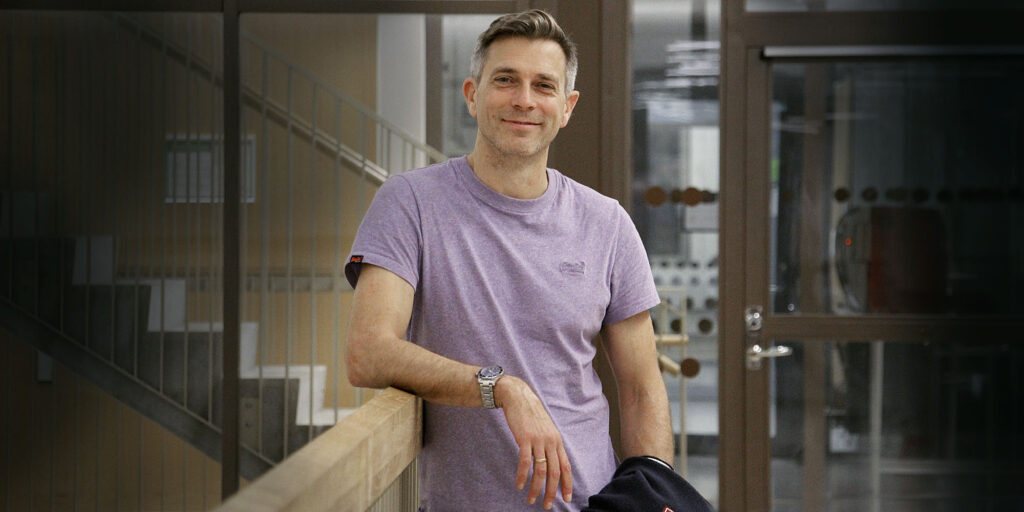
A closer look at the Kosterfjord. Matthias Obst is researching the waters of the Kosterfjord and drawing conclusions about how things like climate change, fishing and traffic affect wildlife. He works with a so-called digital twin, which is used in industrial automation, among other things.
TECHNOLOGY. It was one of the new Swedish words of 2019 – digital twin. Among other things, it has referred to a method for testing automation lines in industry. But the expression has also gained traction in marine research, including for Matthias Obst, associate professor at the Department of Marine Sciences in Gothenburg and affiliated with C2B2.
– We are using that approach in a study of the Kosterfjord, he says.
In general industry, it can be about optimizing the performance of robots, assembly lines or entire factories.
– Digital twins are used to improve manufacturing, for example to make it more profitable or more efficient, says Matthias Obst.
According to him, it is possible to transfer this to the marine world, by assuming that a marine ecosystem is also a kind of factory that manufactures products and that needs to be optimized.
He is currently working on building up pilot studies on how digital twins of the ocean could be used in the future.
Analyzing DNA
Among other things, he and his colleagues are placing DNA sensors in the ocean, in so-called Autonomous Reefs Monitoring Structures (ARMS). The data they receive is then analyzed with DNA tests.
– It is possible to identify the entire biological community and see how it changes over time, or in response to various protective measures and construction processes in the ocean.
Is it mostly about small, microscopic organisms?
– No, it can also be larger animals, but in stages when they are still very small.
The data is analyzed with various software. Then Matthias Obst and his colleagues can obtain the digital twin.
In a current study, the object was the Kosterfjord. There, several hundred species have been monitored to track long-term changes and analyze them in relation to human activities. For example, climate change that increases water temperature or ship traffic that spreads alien species. But also how they react to protective measures such as reducing trawling or nutrient influx.
One tool used in the study is the Subsim platform, where filmed material from underwater environments is analyzed by using AI.
Heat-sensitive organisms move
In September, the study Applying Deep Learning to Quantify Drivers of Long-Term Ecological Change in a Swedish Marine Protected Area was published, which is based on results from the application with the digital twin. In the work, a model for detecting objects has been trained to recognize 17 different bottom-dwelling invertebrates, and they were able to prove, among other things, that climate change is affecting some of the organisms studied.
– Those that are less heat-resistant move to greater depths or decrease in their distribution.
Matthias Obst is also interested in how things like foundations for offshore wind turbines affect wildlife.
– Three-dimensional structures can contribute a lot, but it is something we need to measure and investigate before we know whether it is good or bad.
According to him, we used to look more negatively at this type of impact, now we are talking about designing our ecosystems.
– The classic methods of conducting nature conservation need to be reviewed. We need to use more engineering-based ideas such as digital twins and others to be able to achieve a sustainable ocean.
According to Matthias Obst, their way of working with digital twins will be useful within the UN’s Ocean Decade initiative: The work there started in 2021 and will continue until 2030, with the goal of trying to reverse the downward cycle in terms of ocean health.
In the right place
For Matthias Obs, marine environments are the right element. He was born in Jena in East Germany, 500 km from the coast, and came to Sweden via Denmark in the early 2000s.
– I did my doctorate in Denmark, and came to the research center in Kristineberg in 2004 to do my post-doc.
After that, he settled with wife and family in Gothenburg. Now he has become somewhat Swedish and is, among other things, a dedicated participator in the annual ski race Vasaloppet.
– During the communist era in East Germany, there was a lot of talk about building the perfect society. It was quite unsuccessful. But when I came here to the Scandinavian countries, I thought they had succeeded in achieving the vision that existed in the East during the Cold War.
No thought of moving back to Jena?
– I love that city, but it is too far from the sea.
Facts: Read the study The entire study Applying Deep Learning to Quantify Drivers of Long-Term Ecological Change in a Swedish Marine Protected Area can be read here.
Facts: Matthias Obst
Age: 51 years.
Profession: Associate Professor.
Lives: Gothenburg.
Family: Wife and two children.
Interests: Skiing.
Supports: Qviding FIF football team.
Drives: Volvo V90.