

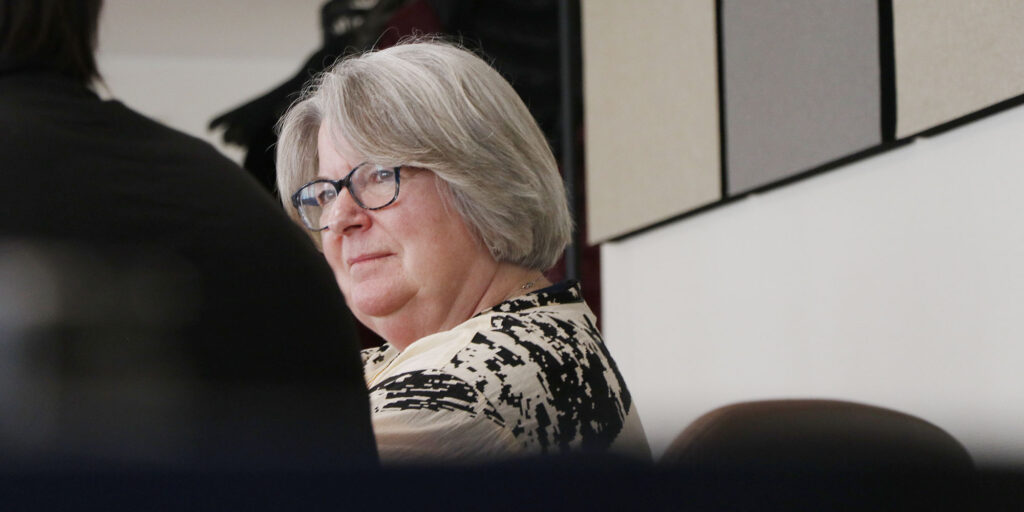
Affects all year around.Gunilla Rosenqvist, project manager for Blue Centre Gotland, is one of the initiators of Baltic Sea Days during Almedalen Week.
– Much of what happens then resonates throughout the rest of the year, she says.
STAKEHOLDERS. Former Swedish prime minister Olof Palme started the trend in 1968, when he chose to hold press conferences from the back of a truck in Visby instead of leaving his summer house to travel to Stockholm. In the 2010s, the sea around Gotland also became a strong voice during Almedalen Week, when Baltic Sea Days were established.
– We approach the Baltic Sea from a broad perspective, says Gunilla Rosenqvist, professor at Uppsala University and one of the initiators of Baltic Sea Days.
Gunilla Rosenqvist has extensive experience in ecology with a focus on marine environments. After completing her PhD in biology at Uppsala University in 1990, she did her postdoctoral research in the United States, in Santa Barbara and Georgia. In the mid-1990s, she became a professor at the Norwegian University of Science and Technology in Trondheim. Since 2017, however, she has been affiliated with Uppsala University. There, she has, among other roles, served as project manager for Blue Centre Gotland.
Part of C2B2
In that capacity, she has also become involved in C2B2 and participated in LL East workshops.
– Blue Centre works with academia, the regional authorities, and the county administrative board. So when C2B2 contacted me, you could say they got all three for the price of one, says Gunilla Rosenqvist.
What is it like to take part in the workshops?
– We come from very different backgrounds, but everyone contributes something. When we meet, we identify things to work on in order to find solutions. I strongly believe in that—collaboration.
With several conflicting interests meeting in the area, Gotland is interesting in many ways for a research programme like C2B2.
– We have wind power, the military, water issues, and industry. You could say the island is like a miniature Sweden.
She lives in Gothem on the eastern side of Gotland, known among other things for its church, which dates back to the 13th century.
In 2014, Gunilla Rosenqvist was one of those who initiated Baltic Sea Days, an event during Almedalen Week featuring seminars and discussions focused specifically on the Baltic Sea.
– The first year we ran the programme for the entire week. But over time, we have concentrated it into one and a half days.
Several on site
This year, the programme takes place on the afternoon of Wednesday, 24 June, and throughout Thursday, 25 June. Several people connected to C2B2 will be present, including participants in the seminars “Nature-Security Nexus in the Baltic Sea Region” and “Security and cooperation in the Baltic Sea – how do we use marine data for both defence and society?”.
– A major advantage of Baltic Sea Days is that what happens there resonates throughout the year. People meet, realise they share common interests, and find opportunities for collaboration, says Gunilla Rosenqvist.
Among the topics on this year’s agenda are dwindling freshwater resources, planning conflicts, wind power, and various other environmental issues.
You have been in academia for a long time—what is the current climate like?
– Universities are struggling with cutbacks, and neither they nor the environment seem to be top priorities for the government. That worries me.
Facts: All aboard
For those taking the ferry from Nynäshamn and choosing the departure on Wednesday, 23 June at 14:35 aboard M/S Gotland, there will be a C2B2 workshop to attend. The workshop is led by Torsten Linders, University of Gothenburg, and Karina Barquet, RISE.
Location: Small conference room, deck eight, aft.
Facts: Gunilla Rosenqvist
Age: 67.
Lives: Gothem, Gotland.
Family: Partner.
Interests: The sea and nature.
Supports: Brynäs IF.
Listens to: 1980s music.
Photo: Thomas Drakenfors