
 Svensk version, klicka här.
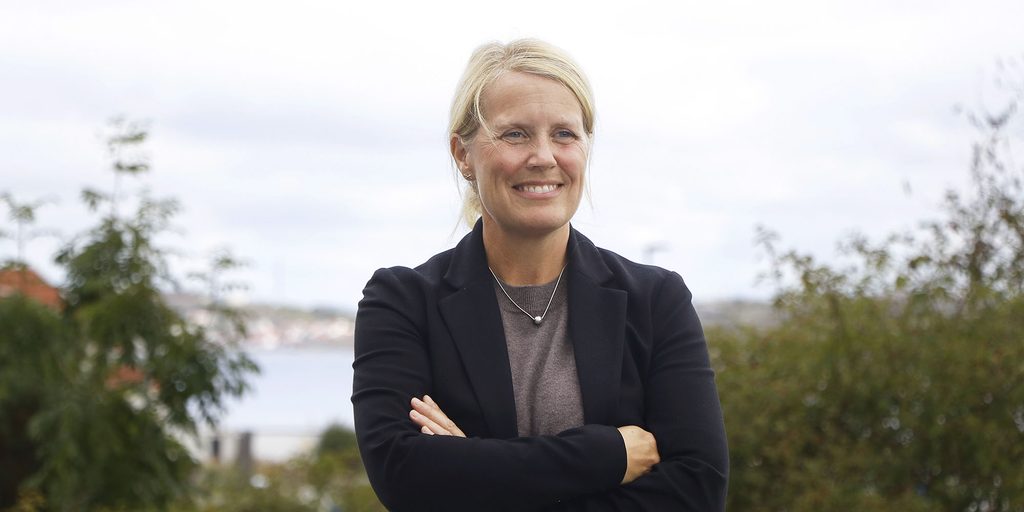
Islands are special. – We who live in the archipelago face particular circumstances. Some things need to be solved differently than on the mainland, says Cecilia Lindblom, municipal controller at Öckerö municipality.
STAKEHOLDERS. Tourists are often drawn to the picturesque. But for people who live on islands, the challenge is to strike a balance between development and preservation. In Öckerö, municipal controller Cecilia Lindblom is involved in various processes of change.
– We need to create the conditions for a sustainable society, she says.
Gothenburg is close by, just a 15-minute car ferry ride from Hönö to the Lilla Varholmen ferry terminal on the mainland. Many people from the city have also found their way to one of the municipality’s residential areas, where the sea is never far away.
The two largest islands, Öckerö and Hönö, are connected by a bridge. Two more bridges make it possible to drive to Fotö and Hälsö as well, giving a road journey of around eight kilometres from north to south. In addition, Öckerö municipality includes a number of other islands that can only be reached by water: Björkö, Källö-Knippla, Hyppeln, Rörö, Grötö and Kalvsund.
– Altogether, we have close to 13,000 inhabitants, says Cecilia Lindblom, who receives us at the modern municipal offices, just a stone’s throw from Öckerö harbour.
Wants to grow
But that figure could grow considerably, which would be welcome. Öckerö wants to develop. From the window of the conference room where Cecilia Lindblom is meeting us, you can see Båken, the municipality’s first high-rise building, rising 13 storeys above the surrounding buildings.
The first residents will move into its 58 state-of-the-art condominiums in spring 2027. The building will also contain a number of premises available for lease to businesses. The name is believed to refer to the Lekskär beacon and lighthouse in the Marstrand fairway, around nine nautical miles north of the municipal offices in Öckerö.
But Båken is only the beginning. The municipality is now aiming to grow by another 1,000 homes by the mid-2030s.
More residents are welcome.
– They are needed to sustain the community and all its services, says Cecilia Lindblom.
A larger population could also help justify measures such as making last year’s pilot passenger ferry service directly to Stenpiren in Gothenburg permanent. The temporary service – a collaboration between Öckerö municipality, Västtrafik, Styrsöbolaget and boatbuilder Candela – covered the route in half an hour.
The municipality is also planning to establish a kind of innovation centre at Öckerö harbour, which currently looks somewhat neglected. The idea is to bring business and research together in order to create competitiveness and development. Something that is welcomed by the local business community.
Took part in international study
From 2024 to 2026, Cecilia Lindblom represented the municipality in an OECD study, Policy Pathways Beyond the Shoreline. In Sweden, only Öckerö and Gotland were invited to participate – the country’s only two municipalities without a fixed mainland connection.
– The study looked at how to create sustainable and resilient island communities in the long term through more place-based policies, better cooperation between different levels of government, and by making use of opportunities in the green, digital and blue economies, she says.
For Öckerö, the study provided new perspectives on how housing, skills supply, population growth and a thriving business community can develop in tandem.
According to Cecilia Lindblom, island communities are not always viewed in terms of their particular circumstances when society is planned.
– Schools are one example. It can be more difficult for us to achieve the same number of pupils as on the mainland and create the conditions for cost-effective operations.
But that is just one example of what she describes as a kind of geographical blind spot. She uses the term Island proofing.
– It means that we need to consider the particular circumstances of islands when we formulate national policies, she says.
A general solution can have very different consequences on an island than on the mainland.
– Something that is important to take into account.
Another example is that proximity cannot always be measured in kilometres alone. Öckerö is close to Gothenburg, but for islands without a fixed mainland connection, ferry services and travel times also play an important role in accessibility.
– The water barrier makes a difference, but that is sometimes forgotten in the debate.
Good cooperation in LivingLab West
One of the ideas behind Öckerö’s development is to achieve a balance between housing, people and businesses that will enable more people to both live and work in the municipality, while also allowing them to develop professionally at different stages of their lives.
At present, a relatively large proportion of young people move to the mainland after upper secondary school.
– Then many come back when they are around 30 and start a family.
Last spring, Cecilia Lindblom joined C2B2’s LivingLab West, where she contributes important perspectives from the archipelago municipality.
She describes it as a good collaboration.
– Good discussions and a very open atmosphere. I’ve also made some good contacts, she says.
Is LivingLabs a sensible way of working?
– Yes, I think so. Research and innovation need to translate into societal development, and I think this is a good example of that.
Öckerö municipality has deep roots in fishing. Considerations relating to the fishing industry were also a factor when the municipality earlier this year rejected plans for an offshore wind farm west of Rörö. In an official statement adopted by the municipality’s political leadership, they referred not only to the impact on commercial fishing, but also to effects on the marine environment, birdlife, the landscape, natural and cultural heritage, and national security.
For Cecilia Lindblom, issues of this kind raise a broader question: how important dialogue is when several interests meet in the same marine area.
Something that is also central to C2B2’s LivingLabs.
– When conflicts between different objectives arise, different perspectives need to be brought in at an early stage so that we can explore what opportunities for coexistence actually exist, she says.
Facts: Cecilia Lindblom
Age: 49.
Occupation: Business economist, working as a municipal controller for Öckerö municipality.
Lives: Hönö.
Family: Husband and three children.
Interests: Experiencing nature, both in the archipelago and in the mountains.
Drives: Volkswagen ID.3.
Miscellaneous: Around the year 2000, Cecilia Lindblom lived in London, where she worked as a controller for Hard Rock Café in London and Edinburgh.“If I ever met a rock star? Yes, among others Bono from U2. He attended a dinner organised by the charity Nordoff & Robbins. Hearing him sing live in such a small setting was a great experience. Unfortunately, I never got the chance to speak to him.”
Facts: Island researchers gather in Öckerö
On 15–16 October, the Swedish Network for Islands Research (SNIR) will hold its third national island research conference: Kunskapsbroar för hållbara och resilienta ö-samhällen (Bridging Knowledge and Practice for Resilient Island Societies).
This year’s conference will be held at Kompetenshuset in Öckerö. Among the participants are Godfrey Baldacchino, Professor of Sociology and Island Studies at the University of Malta, and Andrew Jennings, Professor of Island Studies at the University of the Highlands and Islands in Scotland.
The conference is organised by Södertörn University in cooperation with the National Association of Swedish Archipelago Communities. More information and registration can be found here.