

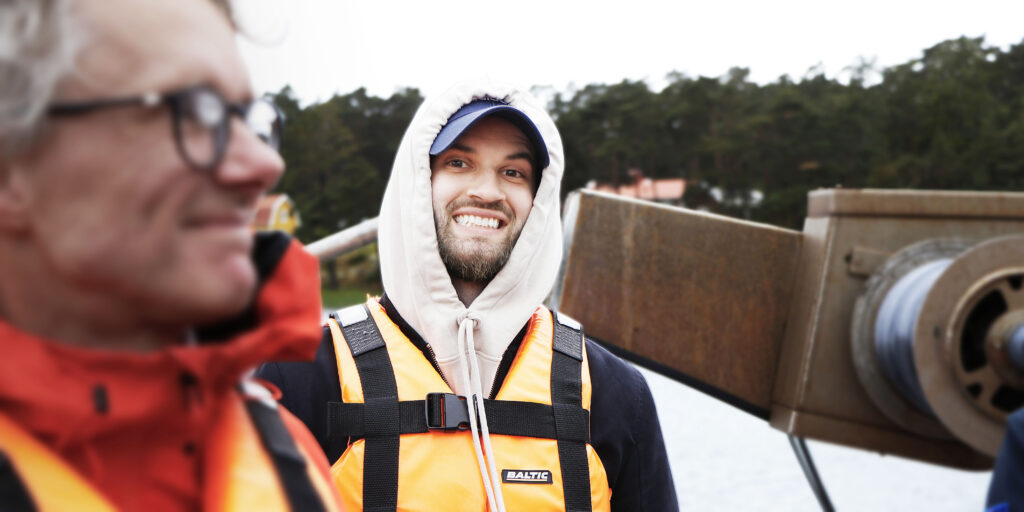
A learning process. – I have learned a great deal through discussions with stakeholders in LivingLab West – insights that would have been much harder to gain in other ways, says Dusan Petrovic, co-lead of C2B2’s LivingLab West.
CO-CREATION. The LivingLabs methodology is a central part of C2B2. It brings together different stakeholders to align perspectives on the blue economy, even when their interests may sometimes conflict.
– The participants clearly have a strong focus on their own perspectives, but at the same time they show an understanding of one another, says Dusan Petrovic, co-lead of LivingLab West.
Dusan Petrovic is a marine biologist by training. Since 2023, however, he has worked as a project manager at RISE, and it was through that role that he became involved in C2B2 in 2024.
In addition to his work as co-lead, Petrovic recently defended a master’s thesis in Sustainability Science, specialising in Environment, Politics and Global Development at Södertörn University.
Conflicts and opportunities
The thesis focuses on the same issues he works with in C2B2: conflicts and opportunities for collaboration between the fishing industry and offshore wind power development in the Southern Skagerrak – the same area covered by LivingLab West.
– I interviewed stakeholders from three groups. Fisheries, offshore wind energy and the public sector. Everyone who participated in the study had also attended our workshops, but their responses were anonymised, he says.
In total, nine people were interviewed. According to Petrovic, the different stakeholder groups in some ways hold fairly predictable perspectives.
– Of course, they want what is best for their own sector. But I would still say that they understand one another’s positions.
According to Dusan Petrovic, the fact that these stakeholders have met and exchanged views within LivingLab West – ten workshops so far – has had clearly benign effects.
– They have moved closer together, and it seems to have become easier for them to contact one another when issues need to be discussed.
Nice attitude
The response to participating in interviews for the thesis was positive.
– Everyone was very helpful. The fact that they already knew me from the workshops certainly made things easier. I also received valuable and constructive feedback on the way we work within LivingLab West, he says.
Dusan Petrovic believes that the workshops play an important role in society. In his view, there is a need for updated processes of this kind, where actors with potentially conflicting interests can meet and engage in dialogue.
They also contribute to valuable knowledge exchange, something he experienced first-hand while conducting the study.
– By talking to stakeholders, I learned things that would have been much more difficult to gain in other ways. Things you cannot easily learn simply by reading consultation documents. Personal contact and conversations with affected stakeholders are essential if you want to understand different perspectives.
An interesting field
He finds working on marine and maritime issues fascinating.
– That applies both above and below the surface, and everything connected to it. As they say … the sea is deep.
What does he personally gain from working with ocean-related issues? Dusan Petrovic, who grew up in Stockholm, says he has always lived close to the sea and maintained a strong connection to it.
– Today I live near a beach. There is something calming about being close to water.
Is there any conclusion from your master’s thesis that you find particularly interesting?
– Several, actually. But if I had to choose one, it would be that the conflicts involved are not only about the sea surface itself. They are also about issues such as access to knowledge. Power and influence are factors that need to be taken into account as well.
How effective are LivingLabs?
– It is a good methodology, but you have to be aware that it takes time. Project periods of two or three years are not enough to create real change. Another important lesson I have learned is that stakeholder dialogue must begin early in a process if it is to be effective. It is also striking how much timing matters to stakeholders”
What do you mean by that?
– Take offshore wind power and the defence sector’s objections to new developments. Ten years ago, nobody was talking about that. And what we will be discussing ten years from now is anyone’s guess.
Facts: Dusan Petrovic
Age: 27
Occupation: Project Manager at RISE
Residence: Huddinge, Sweden
Family: Girlfriend
Interests: Music, fishing, nature and fitness. Former competitive swimmer.
Supports: “Whoever is winning.”
Listens to: Loyle Carner and Raye
Drives: A Mercedes C-Class, although he mostly travels by metro.
Currently: Completed his master’s thesis in June. He is currently working on a scientific article evaluating the work carried out within C2B2. The article is being developed in collaboration with Jessica Hjerpe Olausson at RISE, leader of LivingLab West, researchers Madeleine Prutzer and Andrea Morf at the University of Gothenburg, and Aimee Nuñez Valadez and Megan Smilikis, who also defended their master’s theses in June, both at the University of Gothenburg. Publication is planned for later this summer.
Photo: Thomas Drakenfors, C2B2