

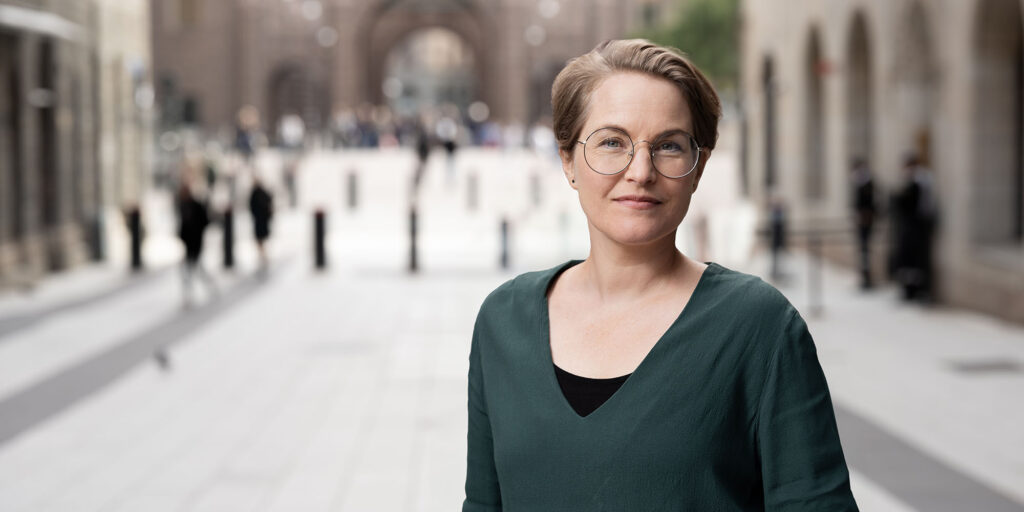
Wind is a winner. Lina Kinning, deputy CEO of Green Power Sweden, is convinced that offshore wind has a strong future. – We should invest in what makes the most economic sense, and in that case wind power is the right choice, she says.
In the debate we sometimes hear that nuclear power is necessary to maintain stable output in the Swedish electricity grid. But Lina Kinning, deputy CEO of Green Power Sweden and, since November, a member of the C2B2 board, believes that this is a myth.
– Without a doubt. It can be solved without nuclear power, she says.
Another common argument that often comes up – almost by default – is that wind power benefits from various forms of government support. But no, says Lina Kinning.
– There are no subsidies. There used to be an electricity certificate system that adjusted the gap between production costs and the market price. But then production costs became so low that the system phased itself out.
Background in the Government Offices
These are issues that Lina Kinning knows well. She holds a bachelor’s degree in chemistry from KTH Royal Institute of Technology and a master’s degree in Sustainable Enterprising from Stockholm University. After completing her studies, she worked at the Swedish Government Offices for both the Ministry of the Environment and Energy and the Ministry of Infrastructure. In 2021 she joined Swedish Wind Energy as head of offshore wind.
Green Power Sweden, where she works today, is a politically independent organization with 180 members. It was created when Swedish Wind Energy and the Solar Parks Network came together under a new umbrella organization in April last year.
Yet despite her role and professional focus, Lina Kinning is not a principled opponent of nuclear power.
– Not per se, no. But we should invest in what is most cost-effective, and then it is not logical to focus solely on building new nuclear power.
And then we have SMR reactors. An exciting new technology, according to Lina Kinning.
– But they seem likely to become expensive.
Wind power is clearly cheaper, she argues.
– Large-scale solar power is also cost-effective.
Wave power?
– It has greater potential in countries with strong tidal flows.
Rapid development in energy storage
One of the most common objections to wind power is what happens when the wind is not blowing. In that sense, nuclear power clearly has an advantage. But Lina Kinning does not accept that argument.
She points to rapid development in different energy storage systems. Pumped hydropower is one example, batteries another. In addition, new technical solutions are emerging, such as so-called STATCOM systems, a power-electronics device used to regulate voltage and increase stability in the electricity grid.
Nuclear power is also not as stable as it is often portrayed, she says. A reactor can suddenly need to shut down due to urgent maintenance needs or similar issues.
– That’s why we have built a system that can handle the loss of extremely large amounts of power.
Nuclear power also has geopolitical challenges, she adds, since Sweden does not mine uranium domestically.
More broadly, she believes the energy debate in Sweden has become strangely polarized. Either one energy source or another.
– That’s something I don’t recognize from other countries.
Joined the board in autumn 2025
In November 2025, Lina Kinning was appointed to the board of C2B2. For her, one of the most interesting aspects is the search for coexistence solutions that takes place in C2B2’s LivingLabs.
– At sea there are many different interests that need to coexist. In C2B2 those questions are brought forward, and people try to find ways to address them. What should cooperation structures look like? Offshore wind depends on our ability to find solutions.
The wind power industry can also contribute to research, she says, because the environmental impact assessments carried out before new developments generate valuable data.
– Both about what happens above and below the surface. Researchers can benefit from that.
At present, Sweden has two offshore wind farms: Kårehamn off the coast of Öland with 16 turbines, and Lillgrund off Malmö with 48 turbines.
Four additional projects have received permits: Kattegatt Syd off Falkenberg, Galene off Varberg, and Poseidon northwest of Gothenburg. Kriegers Flak, several miles south of Trelleborg, has also been permitted, although the investment there is currently considered uncertain.
Still, Lina Kinning is convinced that offshore wind power has a bright future.
– In ten years? Offshore wind will be built widely across Sweden. It is a technology with enormous potential that can generate large amounts of electricity. But it will probably take a decade before we get there.
Facts: Lina Kinning
Age: 46
Lives: Stockholm
Family: Yes
Interest: Music
Drives: I am part of an electric car sharing pool
Facts: Green Power Sweden
The organization was formed in 2025 when Swedish Wind Energy and the Solar Parks Network came together under a common umbrella. Green Power Sweden represents 180 Swedish companies working with large-scale wind power, solar power and energy storage.