

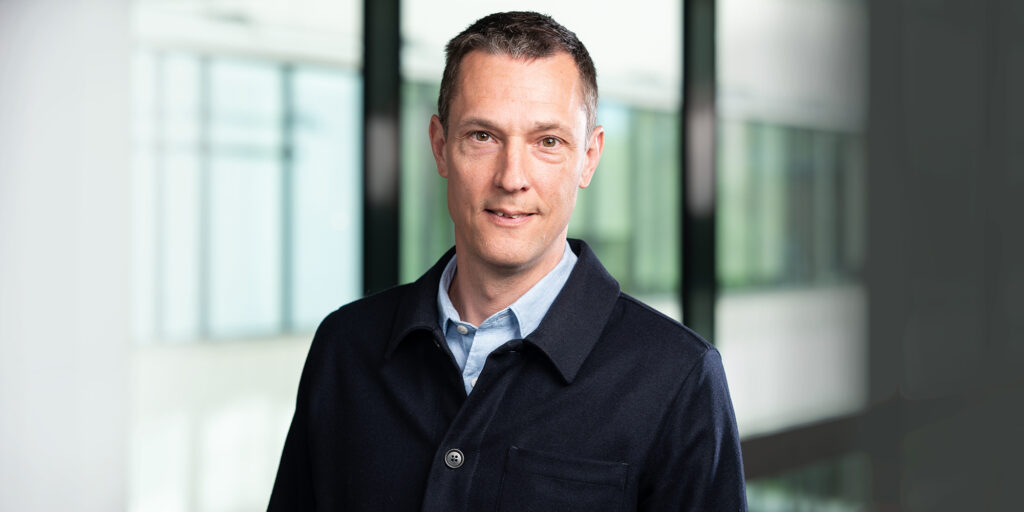
Associated with the programme. Hans Liwång, professor at the Swedish Defence University, collaborates with C2B2. He has participated in Almedalen and co-authored an article in Open Access Government.
– I’m something of a hang-around in the programme, he says.
The Baltic Proper is the focus area for C2B2’s LivingLab East — an international powder keg where tensions between East and West have become increasingly visible. It is also a topic that Hans Liwång, professor at the Swedish Defence University, knows well.
– The central question is how to make the Baltic Sea safer, he says.
For 25 years he has worked at the Swedish Defence University in Stockholm, educating officers. Hans Liwång himself, however, is not a military officer – beyond completing his compulsory military service as an engine mechanic in the navy.
– I’m a civilian employee, he says.
The field he teaches in is technology-focused, and his credentials are extensive.
He holds a Master of Science in Naval Architecture from KTH Royal Institute of Technology and later completed a PhD in shipping and marine technology at Chalmers University of Technology.
Today Hans Liwång teaches defence and security technology, as well as the relationship between technology, strategy and society.
– In recent years, infrastructure and its importance for security have also become increasingly important, he says.
Familiar face in the media
Since Russia invaded Ukraine in February 2022, Hans Liwång’s daily life has increasingly involved appearances in the media.
He and a few others – such as former lieutenant colonel Joakim Paasikivi and Gudrun Persson, an expert on Russian foreign and security policy – possess expertise that has grown exponentially in demand.
– Media interest has increased dramatically, especially after the Nord Stream attack in 2022. Since then I’ve had around 700 media mentions per year. At times there are several interviews per day, he says.
The interviews tend to revolve around the same questions: How safe is Sweden really? What kind of strength does such a small country have when facing a superior military power like Russia?
According to Hans Liwång, the issue must be understood in context. An attack on Finland, Estonia or Sweden would have consequences in the form of a strong response from other European countries.
– The NATO countries in Europe are relatively strong militarily and could create very serious problems for Russia in a confrontation, he says.
Offshore wind and defence
Another kind of confrontation has emerged between offshore wind power and the Swedish defence sector.
According to Hans Liwång, the military’s objections mainly concern the impact that wind farms may have on sensors and surveillance systems on land. But regardless of what Sweden does, he says, offshore wind will still be built in the Baltic Sea and will affect monitoring systems.
– Estonia and Poland are already building, and more projects are underway. It is hard to escape the fact that offshore wind is part of the future.
Nuanced view of NATO
But how beneficial is NATO membership, really?
Asking someone at the Swedish Defence University might suggest an obvious answer. Yet Hans Liwång offers a more nuanced perspective that includes both advantages and drawbacks.
– Membership does not solve all problems. But it strengthens cooperation with our neighbouring countries, Finland, Estonia, Latvia, Poland and Germany. And that is crucial for Sweden’s security.
NATO can facilitate cooperation, he says.
– But it does not replace the need for national responsibility and regional coordination.
A “hang-around” in C2B2
Hans Liwång is not formally part of C2B2. However, he has participated in panel discussions organised by the research programme at Almedalen and co-authored an article in the journal Open Access Government together with people involved in C2B2. A book chapter is also underway.
– I’m something of a hang-around.
Why is C2B2 interesting to you?
– One can note that many people talk about the Baltic Sea. But there is actually relatively little research on how we should develop the protection of marine environments.
Unlike C2B2?
– Yes. A research programme that focuses on the issues C2B2 works with is important, as is ensuring that the results reach our political decision-makers. That creates the conditions needed to safeguard the marine environment around us, which we depend on so much.
Facts: Hans Liwång
Age: 51.
Profession: Professor of Defence Systems at the Swedish Defence University and Visiting Professor in Marine Systems at KTH Royal Institute of Technology.
Lives: Lidingö, Stockholm.
Family: Wife and two children.
Interests: Sailing, archipelago life and orienteering.
Transport: Cycles to work.